
Personal Training After 50: How to Start Strength Training Safely in Sydney
Strength training after 50 is safe and useful for most people when it starts at a manageable level and builds gradually. The safest way to begin is to match exercise to current ability, leave room for recovery, and get help if there are injuries, health conditions, or uncertainty about technique. Australian guidance supports muscle-strengthening activity at least twice a week.

Who this is for
This guide is for adults over 50 in Sydney who are thinking about strength training for the first time, or returning after a long break.
It suits people who want to:
Build confidence with resistance exercise
Manage age-related strength loss
Support balance and everyday movement
Train around a previous injury or ongoing health concern
Get structure instead of guessing what to do in a gym
It is also relevant for people who already walk, swim, cycle, play golf, do Pilates, or stay active in other ways, but have not done much structured strength work.
Personal training after 50 can be useful when the goal is not just fitness, but safer movement, better capacity for daily life, and a plan that respects current limits.
This is not the right starting point for everyone. Seek medical advice first if there is chest pain, unexplained dizziness, fainting, sudden shortness of breath, a recent fall, a new injury, or a major change in health. A personal trainer should not replace a doctor, physiotherapist, exercise physiologist, or other health professional when medical care is needed.
Strength training also may not suit someone looking for a rapid body transformation, extreme exercise, or a short-term challenge that ignores health history. After 50, the focus should be consistent progress, not punishment.
Decision factors
Starting well matters more than starting hard. The right plan should make exercise feel clear, safe, and repeatable.
Start with current ability
The first question is not, “What should a fit 50-year-old lift?”
The better question is, “What can be done well today?”
For one person, that may mean standing up from a chair without using their hands. For another, it may mean learning a hinge pattern, pressing a light weight, or using a resistance band.
A safe starting point usually includes:
Simple movements
Light to moderate effort
Enough rest between sets
No rush to add load
Clear limits around pain and fatigue
Exercise works best as a management strategy when it is matched to the person, not copied from someone else’s plan.
Pay attention to pain and health history
Some discomfort during exercise can be normal, especially when muscles have not been trained for a while. Sharp pain, joint pain that changes movement, or symptoms that linger should not be ignored.
A past back injury, knee pain, shoulder problem, osteoporosis, arthritis, surgery, or heart condition does not automatically rule out strength training. It does change the level of care needed.
Good coaching should help decide when to keep an exercise, change it, reduce the effort, or stop and seek health advice.
Choose exercises that carry over to daily life
Strength training after 50 does not need to be complicated.
Useful movement patterns often relate to normal tasks:
Standing up from a chair
Climbing stairs
Carrying groceries
Getting down to the floor and back up
Reaching overhead
Holding posture while walking
Controlling balance during turns and steps
That does not mean every session should copy daily life. It means exercises should support real function, not just look impressive.
Progress slowly enough to recover
Progress is not only about lifting heavier weights. It can also mean better control, smoother movement, more confidence, less assistance, or doing the same movement with less effort.
Recovery tends to matter more with age, especially after a long break. Sleep, medication changes, stress, illness, and joint irritation can all affect training.
A sensible plan should allow for good and bad days. Pushing through every session is not a badge of honour.
Check the trainer’s scope and communication
A trainer working with adults over 50 should be clear about what they can and cannot do. They should be comfortable adapting exercise, communicating simply, and referring on when a health issue sits outside their role.
Look for someone who:
Asks about health history before training starts
Does not promise cures or guaranteed outcomes
Explains exercises in plain language
Adjusts sessions when symptoms or energy levels change
Treats strength training as a therapeutic tool, not a test of toughness
Think about access and consistency
The best plan will fail if it is hard to attend.
Before choosing a training option, weigh up:
Travel time
Parking or public transport
Session times
Cost over several months
The noise and pace of the training space
How easy it is to keep going during busy weeks
Whether the setting feels safe and comfortable
A plan that happens twice a week for six months is usually more useful than a perfect plan that stops after three weeks.

This article is general information only. It is not medical advice. Anyone with health concerns should seek advice from a qualified health professional before starting or changing exercise.
The case for strength training after 50 is not based on fitness trends. It is supported by public health guidance.
The Australian Government physical activity guidelines recommend that adults do muscle-strengthening activities on at least two days each week, along with regular aerobic activity. The guidance also supports starting gradually, especially for people who are inactive or returning after time away.
For older adults, Australian guidance encourages activity that supports strength, balance, flexibility, and function. That matters because everyday independence depends on more than heart fitness. It also depends on being able to rise, carry, step, reach, and react.
The World Health Organization also recommends regular physical activity for adults and older adults. Its guidance includes muscle-strengthening activity and varied movement for older adults, including balance-focused activity where appropriate.
This does not mean every person over 50 should follow the same plan. Public guidelines give a broad target. Individual exercise still needs to account for:
Health status
Training history
Injury history
Medication effects
Balance confidence
Pain response
Available recovery time
The Better Health Channel, a Victorian Government health resource, advises people to seek medical advice if they have health concerns before becoming more active. That is a practical step, not a barrier. The aim is to start in a way that fits the person.
The main evidence-based point is simple: strength training is recommended for adults and older adults, but it should be introduced at the right level and progressed with care.
Sydney does not change the basic science. It does change the practical side.
People in Sydney often need to plan training around traffic, parking, public transport, work, caring roles, heat, and busy gyms. The right option is one that can be done consistently, not one that looks good on paper.
Local conditions can also affect training choices.
Hot and humid days can make sessions feel harder, especially for people who are returning to exercise. Some people train better earlier in the day. Others need more rest, water, or a lower training load during summer.
Sydney’s built environment also matters. Stairs, sloped streets, uneven footpaths, apartment living, and public transport all place demands on strength and balance. Training can support these daily demands when it is chosen well.
A person who lives in a unit may need better confidence carrying groceries upstairs. Someone who relies on trains and buses may care more about stepping, balance, and getting up from seats. Someone who walks around hilly suburbs may need lower-body strength and pacing.
None of that requires complex training. It requires clear goals and realistic planning.
For many people, the most useful Sydney question is this:
Can this training fit into normal life for the next three to six months?
If the answer is no, the plan needs changing.
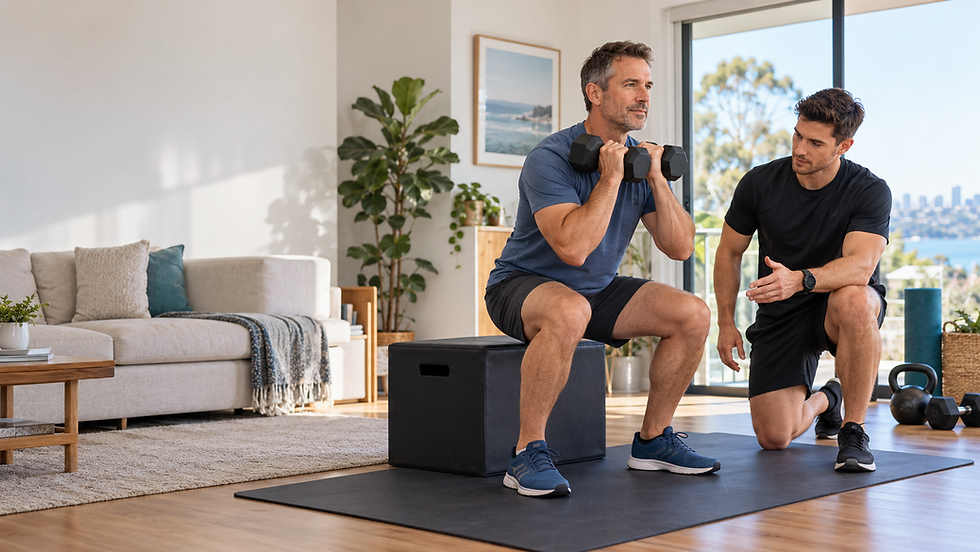
Evidence Based Motion application
Evidence Based Motion works with strength training as a therapeutic tool and management strategy. The focus is on helping exercise fit the person, rather than forcing the person into a fixed template.
Evidence Based Motion begins with an individual consultation and assessment before providing personalised coaching and reviewing progress over time.
That high-level approach suits people who want guidance without extreme training, vague promises, or one-size-fits-all programming. It also suits people who want exercise to connect with daily life, health history, and long-term consistency.
The aim is not to rush. The aim is to build a clear starting point, train with care, and adjust over time.
FAQs
How often should someone over 50 do strength training?
Australian guidance recommends muscle-strengthening activity at least two days a week. Some people may train more often, but the right frequency depends on current fitness, health history, soreness, recovery, and goals.
Is it too late to start strength training after 50?
No. Many people start later in life. The key is to begin at a manageable level and progress gradually. The goal is not to copy younger gym routines. The goal is to build useful strength in a safe and consistent way.
Should strength training hurt?
Muscle effort is expected. Mild muscle soreness after starting can happen. Sharp pain, worsening joint pain, chest pain, dizziness, or symptoms that change normal movement are not training goals. Stop and seek advice if symptoms are concerning.
Do I need a gym?
Not always. Some people can begin with bodyweight movements, bands, or light weights. A gym can help because it provides more options and support, but the best setting depends on safety, confidence, and consistency.
What if I have arthritis, back pain, or osteoporosis?
Strength training may still be useful, but it needs care. These conditions change how exercise should be introduced and progressed. Seek medical or allied health advice where needed, and choose coaching that takes health history seriously.

Next step
For more background on training support, read the internal guide to personal training with Evidence Based Motion.
If strength training feels like the right next step, apply through the Apply page. Evidence Based Motion will review the application and confirm whether the service is a suitable fit.


Comments